Piraeus has a long recorded history, dating back to ancient Greece. The city was founded in the early 5th century BC, when plans to make it the new port of Athens were implemented: A prototype harbour was constructed, which resulted in concentrating in one location all the import and transit trade of Athens, along with the navy's base. During the Golden Age of Athens, the Long Walls were constructed to fortify the route from the main settlement to the port.
Piraeus has a hot semi-arid climate and is the only area in Greece with this type of climate. Due to summer night land breezes in Athens, Piraeus records high minimum summer temperatures while the mean annual temperature stands at 19.4 °C/66.9 °F.
Our tour took us to the
Acropolis, which is an ancient citadel located on a rocky outcrop above
the city of Athens containing the remains of several ancient buildings
of great architectural and historical significance, the most famous being
the Parthenon.
Our tour was followed by a light lunch in Plaka, the old preserved
district of Athens.

The start of the many, many stairs leading up to the Acropolis. The hill it sits on is surrounded by olive and other trees all around the base of the hill.

The Acropolis of Athens
The Acropolis of Athens is an ancient citadel located on a rocky outcrop above the city of Athens and contains the remains of several ancient buildings of great architectural and historical significance, the most famous being the Parthenon, seen towering above the surrounding walls.

Our ascent up the steps offered several stunning views along the way, which were welcome opportunities for a brief rest.

The Athens area consists of several hills, one of which is seen on the right and the municipality of Piraeus sits at the foot of the hill on the left. In the foreground are some of the walls of the ruins.

Herodes Atticus Theater
Further up we came across the ruins of the Herodes Atticus Theater, also known as the Odeon, is a Greco-Roman theatre built in 161 AD. It is named after an affluent Greek born Roman senator, Herodes Atticus, who constructed it in commemoration of his wife, Regilia. Able to seat up to 5,000 people, the Theatre of Herodes Atticus was mostly used for music shows and festivals, a function which the now restored structure still performs today.

That's Rosemary and Izak on the right. The earpiece Izak is wearing part of the tour experience allowing us to get a running dialogue of what we were seeing.
The walls in the background shows the erosion of the limestone covering the rocks

Based on the number of people making their way up the numerous steps, the Acropolis is a very popular tourist .attraction

The Propylaea
Our climb took us to the Propylaea, the classical Greek Doric building complex that functioned as the monumental ceremonial gateway to the Acropolis. Built between 437 and 432 BCE as a part of the Periklean Building Program, it was the last in a series of gatehouses built on the citadel.

The Temple of Hephaestus
The Temple of Hephaestus or Hephaisteion is a Greek temple that remains preserved mostly as built. It is a Doric temple located at the north-west side of the Agora of Athens on top of a hill. The temple is named in honor of Hephaestus, who was the patron god of metalworking, craftsmanship, and fire. Construction started in 449 BCE, and after significant funding delays, the temple was officially completed and inaugurated in 416–415 BC.

The city of Athens with one of the many mountains surrounding it in the background.

Another view of Athens as seen from the top.

The Erechtheion or Temple of Athena Polias/Nike
The Temple is an ancient Greek Ionic structure primarily dedicated to the goddess Athena. In other instances it is referred to as the Temple of the Polias. The joint cult of Athena and Poseidon-Erechtheus appears to have been established on the Acropolis at a very early period, and they were even worshipped in the same temple as may, be inferred from two passages in Homer and also from later Greek texts. Its precise date of construction is unknown, although thought to be from circa 443–406 BC.

Time for a rest.

I haven't been able to find out what this is, but it made for a nice picture.

Rosemary and I headed towards the The Parthenon.

The Parthenon
The Parthenon is a former temple on the Athenian Acropolis, Greece, that was dedicated to the goddess Athena during the fifth century BC.
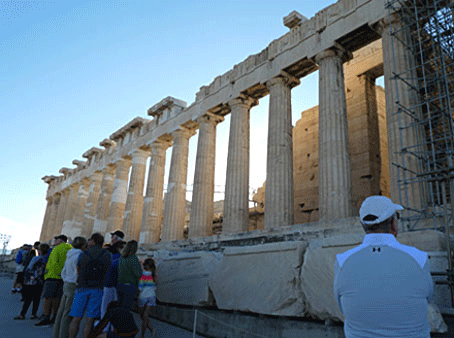
The Parthenon was built from 447 to 438 BC in thanksgiving for the Hellenic victory over Persian invaders during the Greco-Persian Wars. Like most Greek temples, the Parthenon also served as the city treasury.

The Porch of the Maidens
On the south end of the Erechtheion is the Porch of the Maidens, the roof of which is supported by six caryatids. A caryatid is a sculpted female figure serving as an architectural support taking the place of a column or a pillar supporting an entablature on her head. These are now replicas, as the originals are in the Acropolis Museum (with one in the British Museum).

Much of the site has not been reconstructed and remains unchanged since the excavation. In the distance is Mount Lycabettus, a Cretaceous limestone hill. At 277 m/908 ft above sea level, its summit is the highest point in Central Athens with pine trees covering its base. The hill is a tourist destination and can be ascended by the Lycabettus Funicular, a funicular railway which climbs the hill from a lower terminus at Kolonaki railway station.

One of the areas still being worked on.
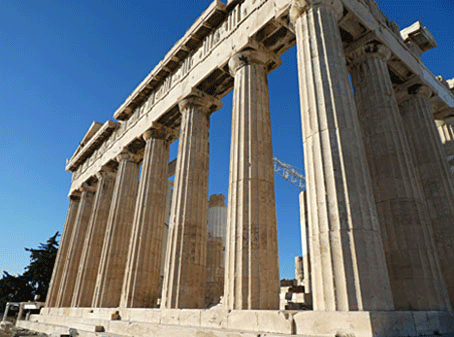
Another view of The Parthenon

... and another.
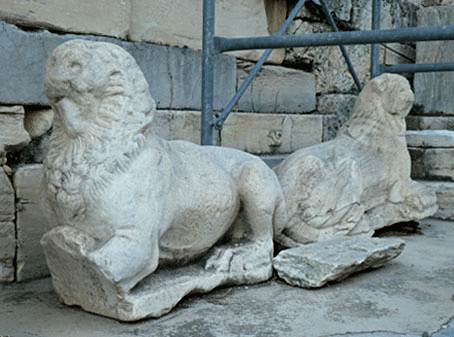
A pair of stone lion monuments situated at the Beule Gate.

Back at the bottom of the hill to board the bus for a brief tour of Athens.

Hellenic Parliament Building
The Hellenic Parliament is the unicameral legislature of Greece, located in the Old Royal Palace, overlooking Syntagma Square in Athens. The parliament is the supreme democratic institution that represents the citizens through an elected body of Members of Parliament.
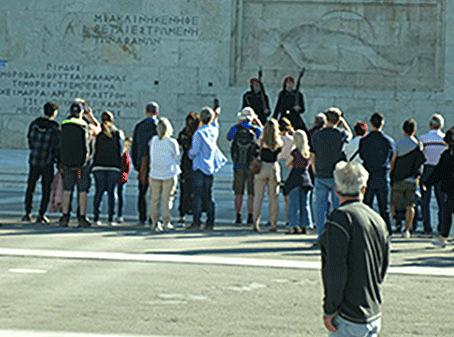
Tomb of the Unknown Soldier
The Greek Presidential Guard stands guard in front of the war memorial located in Syntagma Square near the Old Royal Palace. The cenotaph is dedicated to the Greek soldiers killed during war. It was sculpted between 1930 and 1932 by sculptor Fokion Rok.

The National Academy Library
Also know as the National Library of Greece is the main public library of Greece, located in Athens. Founded by Ioannis Kapodistrias in 1832, its mission is to locate, collect, organize, describe and preserve the perpetual evidence of Greek culture and its uptake over time, as well as important representative evidence of human intellectual production.

Metropolitan Cathedral of Athens
The Metropolitan Cathedral is an important Greek Orthodox cathedral and the largest church in Athens. When Athens became the capital of Greece in 1834, a cathedral was needed here. Construction on the Metropolitan began on Christmas Day in 1842 with the laying of the cornerstone by King Otto and Queen Amalia.

The Little Metropolis
The Little Metropolis, formally the Church of St. Eleutherios or Panagia Gorgoepikoos, is a Byzantine church located at the Mitropoleos square, next to the Metropolitan Cathedral of Athens.

The interior of The Little Metropolis
Its interior was originally decorated entirely with frescoes, but only one of these survives today: an image of the Panagia over the entrance apse.

Some of the relics in the tiny church.

Another view of the vestibule.
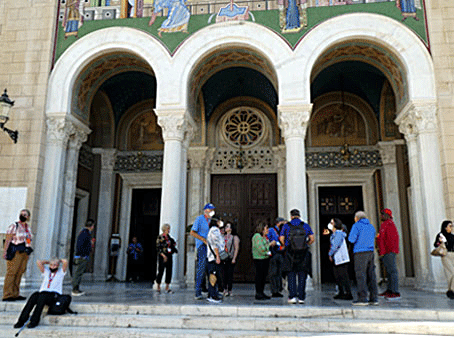
The magnificent entrance to the Cathedral.

A closer look at the entrance, where you can see the artwork over the doors, on the ceiling and in the archways.

And finally, a light lunch and cappuccino at a small cafe in the Central Square.