The Greek name, Kerkyra or Korkyra, is related to two powerful water deities: Poseidon, god of the sea, and Asopos, an important Greek mainland river. According to myth, Poseidon fell in love with the beautiful nymph Korkyra, daughter of Asopos and river nymph Metope, and abducted her. Poseidon brought Korkyra to the island and, in marital bliss, offered her name to the place: Korkyra, which gradually evolved to Kerkyra (Doric). They had a child they called Phaiax, after whom the inhabitants of the island were named Phaiakes, in Latin Phaeaciani. Corfu's nickname is the island of the Phaeacians.
Corfu has a hot summer Mediterranean climate The average daily temperature in the Winter is around 14.2 °C/57.6 °F, while it is 31.3 °C/88.3 °F in the summer. The average night temperature is 5.7 °C/42.3 °F in the winter and 18.4 °C/65.1 °F in the summer.
Our tour took us to the Mon Repos Palace on top of Analipsis hill, near Kanoni area. It was built in 1826 by the British Commissioner Frederic Adams as a gift to his Corfiot wife, Nina Palatianou. The palace has been restored and currently hosts a museum that includes many Ionian treasures.
Of course our tour was followed by enjoying a cappuccino at a outdoor small cafe.

Approaching the island of Corfu.

On our way to the Mon Repos Palace, we passed this small ruin. No idea what it was but it looked kind of interesting.

Mon Repos Palace
The palace became the summer residence of all British governors of Corfu and when the Ionian Islands were united to Greece, in 1864, it was given as a gift to King George I of Greece. This is also the house where Prince Phillip, Duke of Edinburgh, the husband of Queen Elisabeth II, was born.

The Drawing Room
The interior design is in the Regency Style of the early 19th century, and is furnished with items belonging to Lord and Lady Adam (1828-1831).

The walls are decorated with portraits of the various occupants of the home.

Unfortunately we weren't allowed in the room to see who the portraits were of.

Across the hall is a similar room with one of Lady Adam's dresses on display.

The vestibule is two stories high and is capped with an impressive domed ceiling.

One of the rooms contained a map of the Mediterranean Sea.
At this point I decided there was nothing more I wanted to see in the Palace and when the rest of the tour group headed up the the first floor, I headed outside.

As Mon Repos is located on a hill in the forest of Palaiopolis, it offered spectactular views of the Ionian Sea.

The walkway from the Palace headed back to the bus.
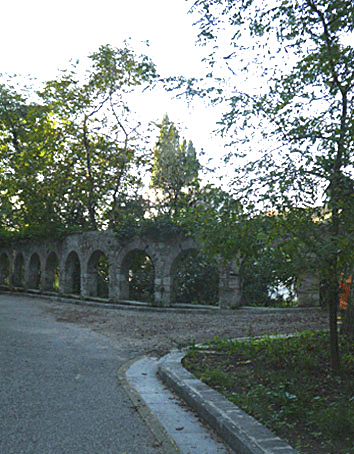
An old stone wall lining part of the path.

The bus took us up the hills of Kanoni, which provided stunning views of the island.

We stopped at one of the many cafes in the hills to enjoy the view.

The far island is known as Pontikonisi, meaning "Mouse Island". Its prominent feature is the Byzantine chapel of Pantokrator, dating from the 11th or 12th century. The near island is home to the church of Panagia Vlacherna. A narrow 300m passageway connects the island with the church. Constructed in the 17th century, this lovely chapel has an impressive wooden carvediconostasis and beautiful frescoes inside.

Another restaurant/cafe overlooking the sea and Mouse Island.
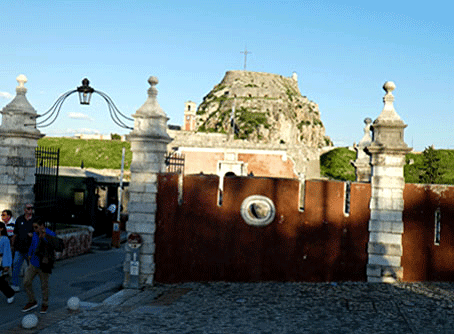
Palaio Frourio
On our way back to the port we passed the entrance to Palaio Frourio which translates as "the Old Citadel". The Citadel is an old Venetian fortress built on an artificial islet with fortifications surrounding its entire perimeter. The interior has been restored and is used for cultural events, such as concerts and historical recreations. The central high point of the citadel was a military observation post, with a giant cross at its apex.

Corfu Central Square
Before returning to the ship, the bus dropped us off for a "walk-about" in the main square . . .
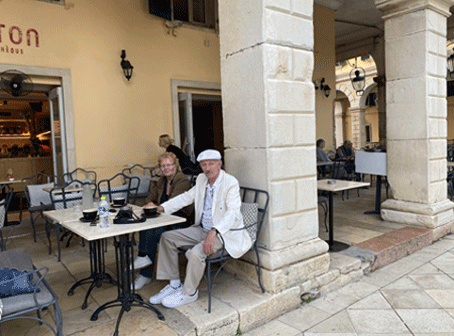
. . . So we opted for a cappuccino instead.